Blog
Exosome Therapy for Hair Loss A Complete 2026 Guide

Exosome therapy for hair loss in Pakistan is the newest serious contender in non-surgical hair restoration, and clinics here are only beginning to offer it. If you have tried oils, supplements, or even PRP with underwhelming results, exosomes represent the next generation of regenerative treatment — one built on cell-signalling science rather than folklore. This complete 2026 guide explains what exosomes actually are, how the treatment works, how it compares to PRP, and what to expect if you book exosome hair treatment in Islamabad.
What Are Exosomes?
Exosomes are microscopic vesicles — tiny messenger packets released by cells — loaded with growth factors, proteins, and signalling molecules. Think of them as the body's biological couriers: they instruct nearby cells to repair, regenerate, and grow. In hair restoration, lab-purified exosomes derived from stem cell cultures are applied to the scalp, where they signal dormant hair follicles to re-enter the active growth phase.
The key difference from older treatments: exosomes deliver a far higher concentration of growth factors than the body can produce on its own, which is why early clinical results have generated so much attention internationally.
How Does Exosome Therapy for Hair Loss Work?
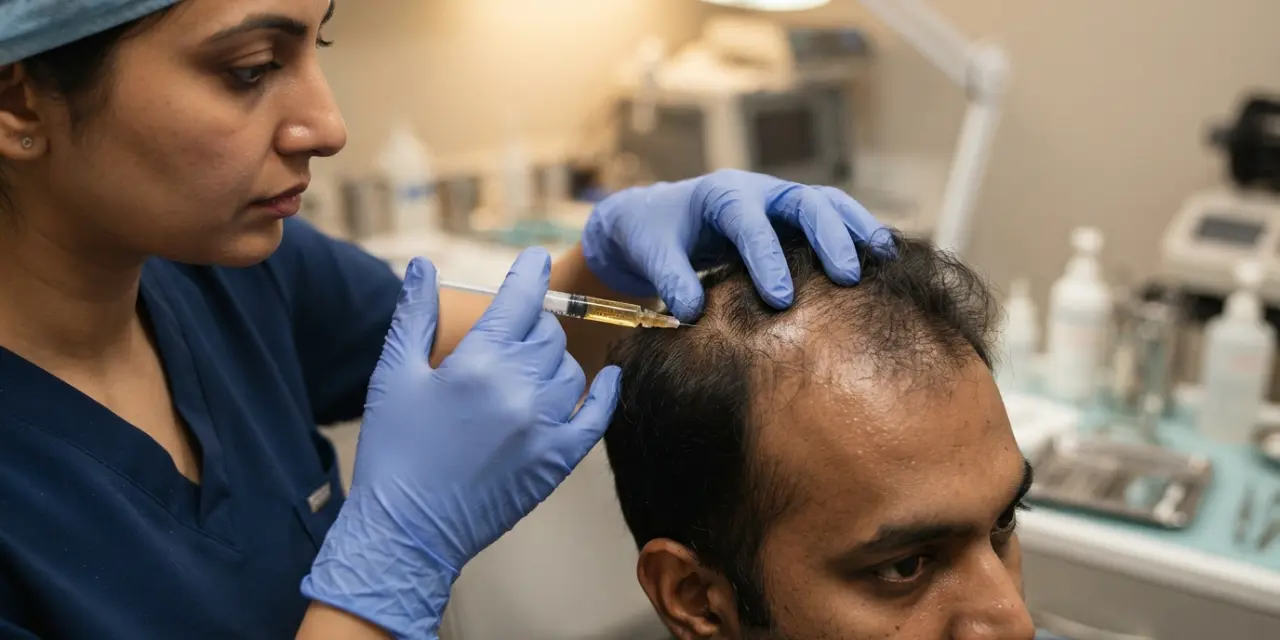
The procedure itself is straightforward. After a scalp assessment, a numbing cream is applied, and the exosome solution is delivered into the thinning areas through microinjections or microneedling channels. The session typically takes 45–60 minutes, and you can go back to your routine the same day with only minor scalp sensitivity.
Over the following weeks, the exosomes signal follicles to shift from the resting (telogen) phase into the growth (anagen) phase. Most clients notice reduced shedding within 4–6 weeks, with visible density improvements from month three onwards. Full details of our protocol are on the exosome therapy in Islamabad service page.
Who Is a Good Candidate?
- Men and women in the early to moderate stages of pattern hair loss — thinning, not fully bald areas
- Post-partum shedding or stress-related hair loss (telogen effluvium)
- People who responded partially to PRP and want a stronger regenerative option
- Clients preparing scalp health before or after a hair transplant
Exosomes stimulate existing follicles — they cannot resurrect areas where follicles have completely died. That is why treating early matters: the more dormant-but-alive follicles you have, the better the result.
PRP vs Exosome Therapy: What Is the Difference?
This is the comparison everyone asks about. PRP (Platelet-Rich Plasma) uses growth factors extracted from your own blood, so its strength depends entirely on the quality of your platelets — which varies with age, health, and lifestyle. Exosomes are lab-standardised, so every vial delivers a consistent, concentrated dose of signalling molecules, typically far exceeding what PRP can provide.
- Source — PRP: your own blood. Exosomes: purified stem cell-derived vesicles.
- Consistency — PRP varies person to person. Exosomes: standardised potency every session.
- Sessions — PRP: usually 4–8 sessions plus maintenance. Exosomes: often 1–3 sessions.
- Comfort — PRP requires a blood draw. Exosomes: no blood draw needed.
- Cost — PRP is cheaper per session; exosomes cost more but need fewer sessions.
Many of our Islamabad clients still choose PRP as a proven, budget-friendly starting point — and for a full breakdown of that option, read our companion guide on PRP hair treatment in Islamabad results, cost and sessions needed. Others combine the two, using exosomes to amplify a PRP protocol.
How Many Sessions Are Needed and When Do Results Show?
A typical exosome protocol involves 1–3 sessions spaced 4–8 weeks apart, depending on the degree of thinning. Expect this general timeline: reduced shedding by weeks 4–6, early regrowth of fine hairs around months 2–3, and noticeably improved density between months 4–6. An annual maintenance session helps sustain results, especially in genetic hair loss.
Is Exosome Therapy Safe?
When sourced from certified, lab-tested products and administered by trained practitioners, exosome therapy has an excellent safety profile — no incisions, no general anaesthesia, and because exosomes are acellular (they contain no living cells), rejection risk is minimal. The most common side effects are mild redness, tightness, or scalp tenderness for a day or two.
One honest caveat: exosome therapy is newer than PRP, and long-term data is still accumulating. Choose a clinic that can tell you exactly which exosome product they use and where it is sourced — vague answers are a red flag.
Cost of Exosome Therapy for Hair Loss in Pakistan
Because the exosome product itself is imported and lab-certified, sessions cost more than PRP — exosome therapy for hair loss in Pakistan typically runs PKR 60,000–150,000 per session depending on the product brand and scalp area treated. Fewer sessions are needed, so compare total protocol cost rather than per-session price. For a personalised quote, book a scalp assessment through our hair regrowth treatment in Islamabad page — our team will map your hair density and recommend exosomes, PRP, or a combination honestly.
Frequently Asked Questions
Yes — select advanced aesthetic clinics in Islamabad and Lahore now offer exosome hair therapy in 2026, using imported, lab-certified exosome products applied via microinjection or microneedling.
Exosomes deliver a higher, more consistent concentration of growth factors and usually require fewer sessions (1–3 vs 4–8 for PRP). PRP remains a proven, more affordable option. Many clients combine both.
Results typically develop over 3–6 months and can last 12 months or longer. In genetic hair loss, an annual maintenance session is recommended to sustain density.
Numbing cream is applied first, so most clients feel only light pressure. There is no blood draw, and scalp tenderness afterwards settles within a day or two.
No. Exosomes reactivate weakened or dormant follicles — they cannot revive follicles that have fully died. Completely bald areas usually require a hair transplant instead.